β: This English translation is in beta — the Traditional-Chinese original is the authoritative version.
Lab 12 — From jitter to eye to BER (SerDes bathtub)
Breadcrumb: Simulation labs › Noise & jitter › This page (eye / BER bathtub). Upstream: lab_08, lab_11; downstream: lab_13.
This lab settles, once and for all, the "why care about jitter" question of the whole ISF course: the oscillator's phase noise integrates into rms timing jitter (see lab_08); this is the random jitter (RJ) of the SerDes sampling clock; RJ closes the eye diagram (the opening formed by overlaying many bits) and sets the BER (bit-error rate). We plot the eye diagram and the BER bathtub (a curve of BER versus sampling instant, shaped like a bathtub).
Physical intuition (conclusion first): an ideal clock always samples at the exact center of the UI (unit interval, the time span of one bit), away from either data edge — the safest spot. With jitter, the sampling instant wanders randomly left and right; whenever it wanders past either edge, the wrong bit is sampled. RJ is Gaussian and unbounded, so there is always a tail that crosses an edge — the BER is always ; its size is set by "how many you sit from the edge". The more of margin, the error probability drops exponentially via (the Gaussian tail) — which is why the bathtub floor is deep and flat.
1. Learning objectives
- Map rms jitter to eye closure and BER.
- Write down and understand the RJ-only BER bathtub formula (the SerDes BER expression of spec section 10.2).
- See that "larger → narrower usable sampling window (eye opening at a target BER)".
- Link the -function (Gaussian tail) with "how many from the edge" to grasp the BER's exponential sensitivity.
2. Mathematical model
-function (Gaussian tail probability).
the probability that a standard Gaussian exceeds . The larger , the smaller (exponential-like decay).
BER bathtub (RJ only). Sample within the UI at offset relative to the eye center, with the left edge at and the right edge at . The sampling instant is dithered by Gaussian jitter ; crossing either edge produces an error (spec section 10.2, "SerDes BER (RJ)"):
- Term-by-term physics: the first term is the probability of jittering past the right edge (distance ); the second is that of jittering past the left edge (distance ). The leading is the bookkeeping for "a transition is present half the time" (RJ-only first-order model).
- Eye center : the two terms are symmetric, — both edges sit away. This ratio is everything: it is called the "eye half-width in units of ".
- Dimension check: the argument of , , is , dimensionless ✓; the BER is a probability (dimensionless) ✓.
The eye half-width (in ) sets the BER. For ps:
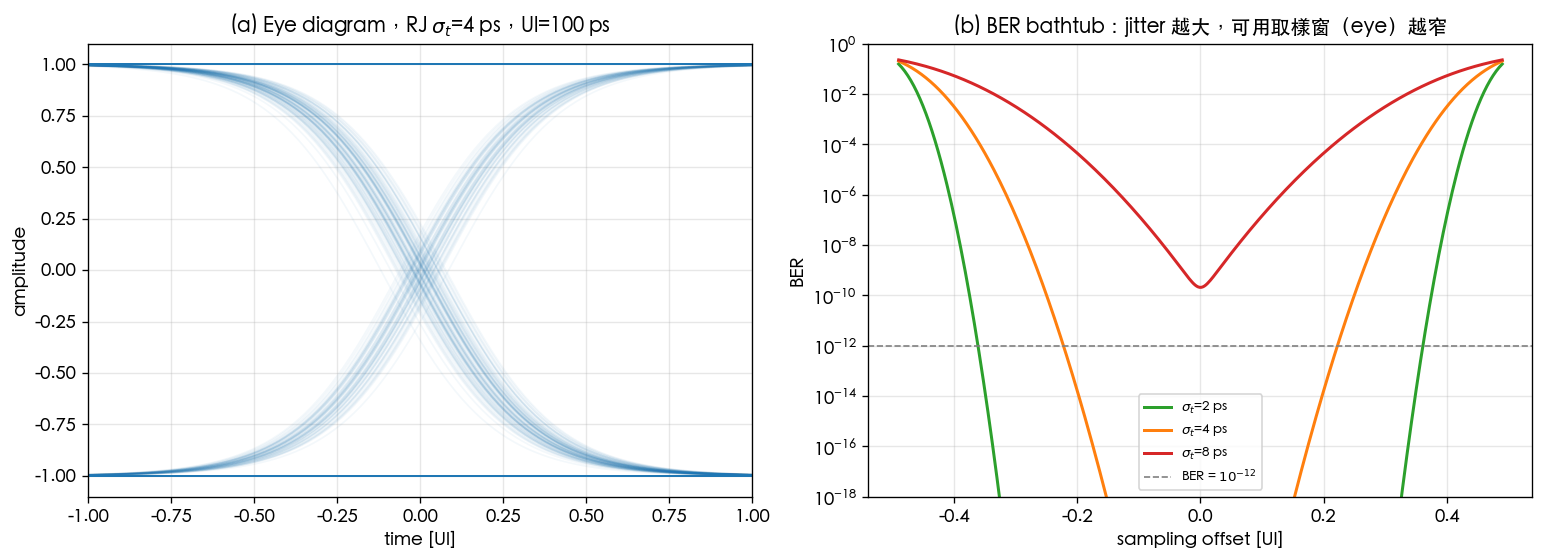
ps → ; ps → . (extremely deep), (much shallower) — double the jitter and the bathtub floor rises by dozens of orders of magnitude.
3. Block diagram
4. Core Python code
Verbatim from main() in simulations/lab_12_serdes_eye_ber.py: the left panel overlays the eye with eye_traces;
the right panel plots bathtub curves for three values of with ber_bathtub.
ui = 100e-12       # 10 Gb/s -> 100 ps UI
sigma_t = 4e-12    # 4 ps rms RJ (e.g. from an integrated 5 GHz clock)

# (a) eye diagram
t, traces = eye_traces(sigma_t, ui, n_traces=300, rng=RNG)
for tr in traces:
    ax.plot(t, tr, color="tab:blue", alpha=0.05, lw=1.0)

# (b) BER bathtub
toff = np.linspace(-ui / 2 * 0.98, ui / 2 * 0.98, 400)
for st, c in zip([2e-12, 4e-12, 8e-12], ["tab:green", "tab:orange", "tab:red"]):
    ber = ber_bathtub(toff, st, ui)
    ax.semilogy(toff / ui, ber, color=c, label=fr"$\sigma_t$={st*1e12:.0f} ps")
ax.axhline(1e-12, color="gray", ls="--", lw=1, label="BER = $10^{-12}$")
The underlying ber_bathtub and Q (serdes_utils.py) are a verbatim implementation of the spec section 10.2 BER formula:
def Q(x):
    """Gaussian tail probability Q(x) = 0.5*erfc(x/sqrt(2))."""
    return 0.5 * erfc(np.asarray(x, dtype=float) / np.sqrt(2.0))

def ber_bathtub(t_offsets, sigma_t, ui):
    t = np.asarray(t_offsets, dtype=float)
    half = ui / 2.0
    ber = 0.5 * (Q((half - t) / sigma_t) + Q((half + t) / sigma_t))
    return np.maximum(ber, 1e-300)
eye_tracesadds jitter to each transition's edge time (in UI units); overlaying 300 traces forms the eye.ber_bathtubapplies the -function directly;np.maximum(ber, 1e-300)puts a floor under the log plot to avoid .
5. Full script path
simulations/lab_12_serdes_eye_ber.py
(Dependencies: Q, ber_bathtub, eye_traces from simulations/common/serdes_utils.py;
savefig from simulations/common/plot_utils.py. Q uses scipy.special.erfc.)
How to run: python scripts/run_all_sims.py.
6. Parameter table
| Parameter | Variable | Value | Notes |
|---|---|---|---|
| Unit interval | ui | s | 10 Gb/s NRZ → 100 ps UI |
| Eye-diagram jitter | sigma_t | s | 4 ps rms RJ (e.g. integrated from a 5 GHz clock) |
| Bathtub jitter sweep | — | ps | three bathtub curves |
| Number of eye traces | n_traces | overlay density | |
| BER sample points | toff | () | bathtub-curve resolution |
| Target BER | — | common SerDes spec line | |
| Random seed | RNG | default_rng(12) | reproducible results |
7. Units table
| Quantity | Symbol | Unit | Value in this lab |
|---|---|---|---|
| Unit interval | s | 100 ps | |
| rms jitter | s | 2 / 4 / 8 ps | |
| Sampling offset | s (plotted in UI units) | ||
| Eye half-width (in σ) | — (dimensionless) | 25 / 12.5 / 6.25 | |
| BER | — (probability) | ||
| argument | — (dimensionless) | number of σ from the edge |
8. Simulation figure
9. How to read the figure
- Left panel (eye diagram): 300 jitter-dithered transitions overlaid, leaving a diamond-shaped eye opening at the center. Jitter smears the edges out and narrows the opening horizontally; with even more jitter the eye closes until no sampling instant is safe.
- Right panel (BER bathtub): three bathtub curves (green/orange/red = ps).
- Floor depth: the smaller , the deeper the bathtub floor (the lower the BER). The green curve (2 ps) bottoms out beyond the plot (, vanishingly small); the red curve (8 ps) only reaches the level.
- Walls: near UI (i.e. the edges) the BER shoots up to (a coin flip).
- Usable window (eye opening @ BER): the span between where the two walls cross the dashed line is the "window in which sampling is safe at that BER". The larger , the narrower this window — this is "jitter eating the timing budget".
- How to use it: given the data rate (UI) and target BER, back out the tolerable ; then require the clock's integrated phase noise to stay below that (closing the loop with lab_08).
10. Corresponding paper equations/figures
- BER formula: spec section 10.2, "SerDes BER (RJ)": , . Generic communications/SerDes practice — external literature, not among the five source PDFs — supplemented from standard references.
- Jitter source: comes from integrating the phase noise (spec Eq. 19, see lab_08); the underlying phase-accumulation mechanism traces back to the ISF/LTV model of [P1] and the jitter discussion in [P2].
- RJ Gaussian and unbounded: consistent with the Monte-Carlo conclusion of lab_11 (Gaussian tail → BER always ).
- Corresponds to site figure
serdes_eye_ber_bathtub.png; for the design-level chain see serdes_clocking_connection.
11. Limitations and approximations
- This is a pedagogical toy model, not transistor-level: the eye approximates NRZ transitions with
tanh-smoothed edges and has no real channel/equalizer; the BER uses the closed-form expression, not Monte-Carlo error counting. - RJ-only (random jitter only): ignores DJ (deterministic jitter — bounded, from ISI, duty-cycle distortion, crosstalk, etc.). Real jitter is dual-Dirac (RJ ⊛ DJ); DJ pushes the bathtub walls inward and puts a plateau on the floor. This lab demonstrates only the Gaussian-tail RJ part.
- No amplitude noise / vertical eye closure: timing only (horizontal eye); vertical closure from voltage noise is not included.
- Ideal two-level signaling, no ISI: assumes clean transitions between adjacent bits and no inter-symbol interference; practical high-speed channels need CTLE/DFE equalization.
- The bookkeeping: transition density taken as 0.5 (random-data average); specific patterns will differ.
Key takeaways
- Integrated phase noise → → RJ of the SerDes sampling clock → eye closure → BER.
- ; at the eye center .
- The key quantity is the eye half-width in units of , : double the jitter and the BER floor rises by dozens of orders of magnitude.
- Gaussian RJ is unbounded → the BER is always ; the intersections of the bathtub with the target-BER line bound the usable sampling window.
Further reading
- Where jitter comes from (integration): lab_08_jitter_integration
- Why RJ is Gaussian: lab_11_monte_carlo_jitter
- Reining jitter in with a PLL/CDR: lab_13_pll_cdr_transfer
- Use in design/theory: back out a clock phase-noise budget from the spec → serdes_clocking_connection